

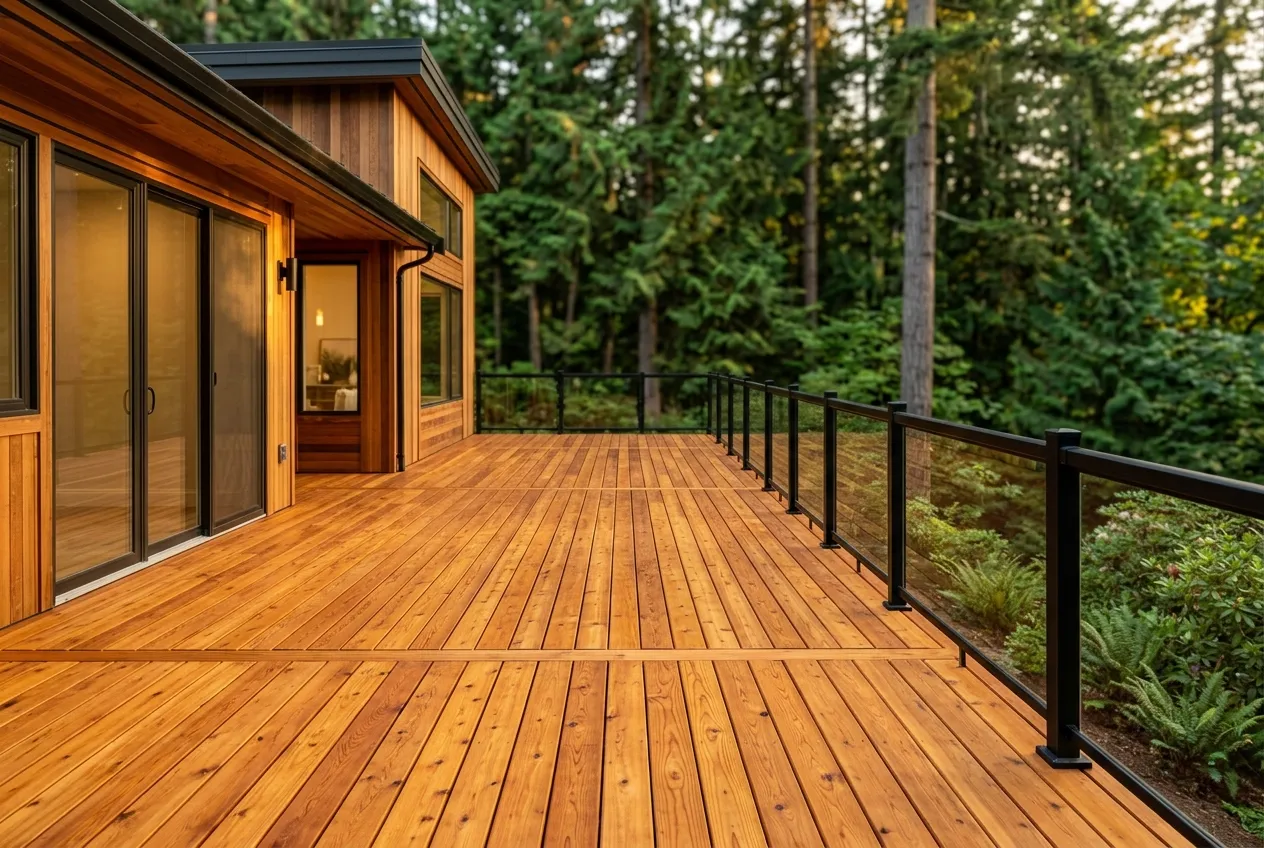
Both are good materials. The question is not which is better in the abstract, it is which is better for a deck that spends eight months a year wet and shaded.
The maintenance cycle is the whole argument
Western red cedar is naturally rot and insect resistant, which is why it has been the Pacific Northwest deck material for generations. What it is not resistant to is weathering. Left alone here, cedar goes silver-grey within a season, and the surface roughens as the soft early wood erodes ahead of the grain.
Keeping cedar looking like cedar means a cycle: clean it, let it dry properly, and re-apply a penetrating stain or oil. In this climate that is realistically every one to two years, and there is a narrow window to do it - the boards need to be genuinely dry, which around here means a stretch of summer.
Composite has no such cycle. It is cleaned with soap and water and that is the end of the obligation.
That is the entire decision for most people. Not cost, not appearance. Whether you will do the work every summer for the next twenty years, or whether you will intend to and then not.
Two situations tilt it further than average. A surface under permanent canopy never gets the drying cycle the maintenance interval assumes, which is why composite wins so often on La Center decks under fir and maple. And on a replacement deck in Gresham, the owner has usually just spent forty years sealing the original and has formed a firm view.
Up-front cost
Cedar is cheaper as a surface material. Composite carries a real premium.
The gap is smaller than it appears in a materials quote, because the substructure is identical. Both decks sit on pressure-treated framing with the same footings, posts, beams and joists, and that framing is a large share of the build. Changing the surface boards changes one line.
The labor is also comparable, with a small edge to composite on some hidden-fastener systems that go down faster than face-screwed cedar.
Cost over time
Cedar’s maintenance is not free. Stain, cleaner, and either your weekends or a contractor’s day rate, repeating every year or two.
Run that out fifteen years and the two materials converge. Run it out twenty-five and composite is usually ahead, because a maintained cedar deck is still likely to need board replacement in that window while a composite deck generally does not.
If you have a short holding period, cedar’s lower entry cost is a genuine advantage. If this is the house you are staying in, the arithmetic favors composite.
How each handles our specific weather
Moisture and rot. Cedar resists decay but is not immune, and the failure points are predictable: where boards sit tight against each other with no drainage, where debris collects, and at the cut ends that never got sealed. Composite does not rot, though the framing underneath still can if it is not detailed properly.
Mold and algae. Both grow it here. Both need periodic cleaning. This is not a differentiator.
Slip resistance. Wet cedar with an aged smooth finish gets slick. Most modern composites have an embossed surface that holds up better when wet. On a shaded north-facing deck under fir - the norm on wooded lots in Hockinson, La Center and Brush Prairie - this is worth taking seriously.
Heat. Composite gets hotter than wood in direct sun, and dark composite gets notably hot. In Clark County we have enough genuinely hot days each summer for this to matter on a south-facing deck with no cover. Lighter colors mitigate it.
Fading. Modern capped composites hold color far better than the first generation did. Cedar left unfinished goes grey by design, which some people want.
Appearance
Cedar is real wood, with the grain variation and warmth that implies, and nothing imitates it perfectly. If the natural material is what you want, that preference is legitimate and no amount of arithmetic overrides it.
Current composites are considerably better looking than the uniform plastic planks of fifteen years ago, with varied grain and multi-tonal coloring. Whether they read as convincing is a personal judgment best made with samples on site rather than in a showroom.
Pressure-treated, the third option
Worth naming because it is the value choice. It is the least expensive surface, it is what the frame is made of anyway, and it takes stain. It moves and checks more than cedar as it dries, and it needs the same finishing cycle. For a utility deck or a tight budget it is entirely reasonable.
Hidden fasteners and drainage
Whichever surface you choose, two details affect how long the deck lasts here.
Hidden fasteners avoid hundreds of face screws that break the surface and let water into the board. Most composite systems use them. Cedar can be installed with them too.
Drainage and spacing matter more in a wet climate than a dry one. Boards need a gap that stays open, and debris between boards holds moisture against the frame. A deck that cannot dry underneath rots from below regardless of the surface material.
What we build most
Composite is the majority of what we install on deck builds across Clark County, and the reason homeowners give is almost always the maintenance rather than the looks or the lifespan.
We build cedar for people who want cedar and know what the upkeep is. That is a good outcome too, as long as it is a decision rather than a surprise.
Either way the frame is pressure-treated, the ledger is flashed properly into the house, and covered builds get tied into the existing roof by our roofing crew rather than caulked in. More on the wider budget in what a deck costs to build in Clark County.