

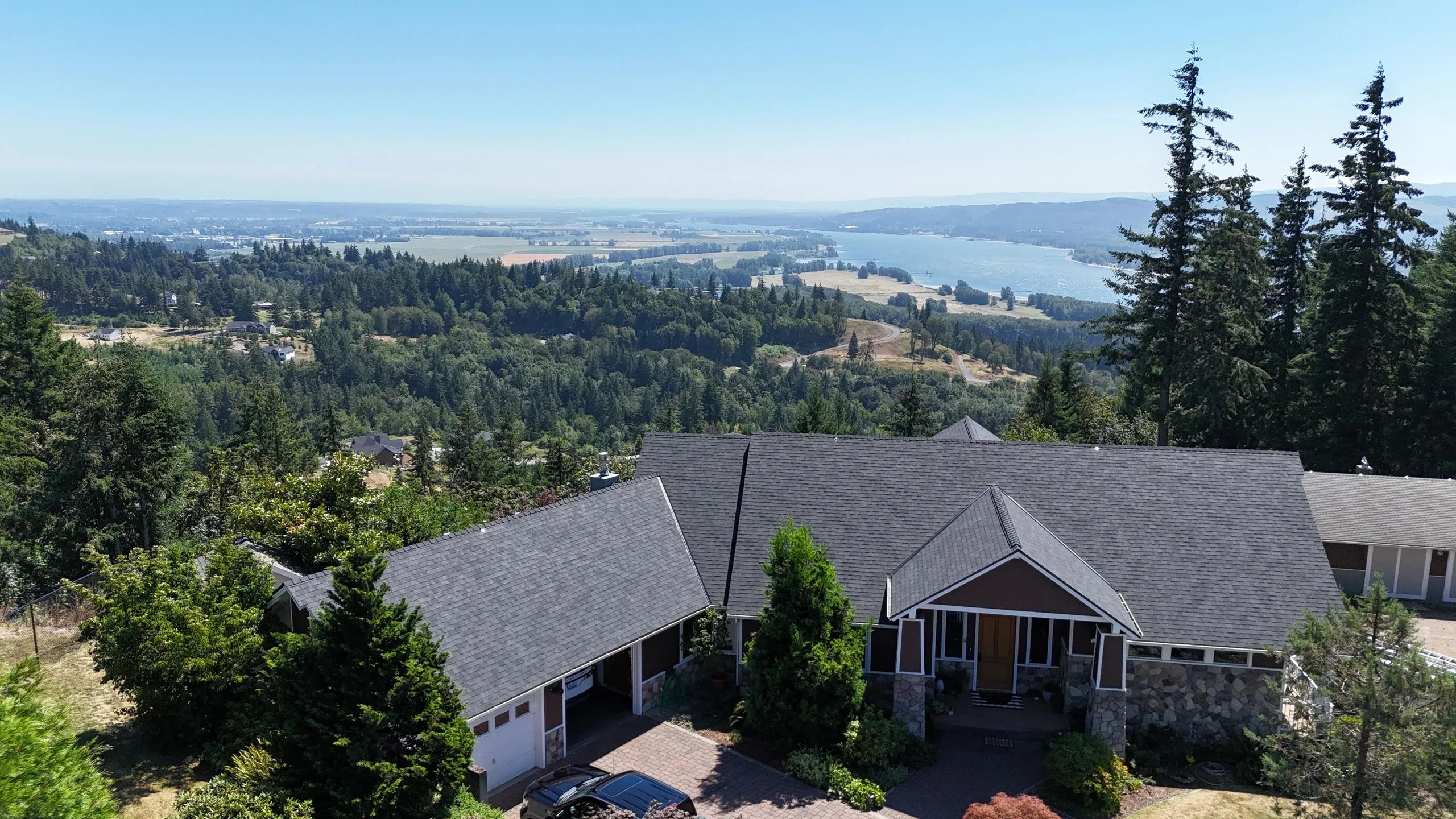
Moss is the defining roof problem in western Washington. It grows on the north slopes, under the fir canopy, in the shade of anything tall - which describes most of Felida, Hockinson and La Center - and it does real damage: it holds water against the shingle, lifts the edges as it thickens, and works granules loose.
It is also the roof problem homeowners most often make worse, usually with a pressure washer.
Never pressure wash an asphalt roof
This is the one rule to take away.
The Asphalt Roofing Manufacturers Association is unambiguous: “Never use a pressure washer to clean an asphalt shingle roof as this will cause granule loss” and very likely premature failure of the roof system.
Oregon State University Extension gives homeowners the same warning in its guidance on roof moss, advising a brush or broom and specifically cautioning against high-pressure devices, because the pressure strips the mineral granules that were applied to the shingle at manufacture. Those granules are the shingle’s UV protection and its wear surface. Once they are gone, the asphalt underneath is exposed and the shingle ages fast.
A pressure-washed roof looks dramatically better for about a season and then ages years in a hurry. We have replaced roofs that had a decade left before somebody cleaned them.
What actually kills moss
ARMA’s recommended treatment is a 50:50 mix of laundry-strength liquid chlorine bleach and water, applied with a sprayer and allowed to dwell for 15 to 20 minutes, then rinsed with low-pressure water. Severe growth can need more than one treatment.
Two practical notes if you do this yourself. Protect the landscaping below - bleach solution running off the eaves will damage plants, so wet them down first and rinse afterward. And wear proper eye and skin protection.
Commercial zinc-based and copper-based moss treatments are the other common option, sold as granules or sprays. They work more slowly and are gentler on surrounding plants than bleach.
Then remove it gently
Killing moss does not remove it. Dead moss stays put and keeps holding water.
The safe sequence is to let it die and dry, then remove it with low force. ARMA notes moss will loosen over time and can be taken off with a leaf blower. OSU Extension recommends a stiff broom or a standard bristle scrub brush.
Work downward, in the direction the shingles lay. Brushing upslope lifts the shingle edges and can break the seal tabs, which is how a cleaning turns into a wind-damage problem in the next storm.
Do not scrape. A putty knife or a shovel on a roof takes granules with the moss.
Does Dawn dish soap kill moss on the roof?
Not reliably, no. Dish soap is a surfactant, not a biocide. It helps a solution wet and cling to a surface, which is why it turns up in homemade recipes as an additive, but on its own it does not kill moss.
You may see visible improvement immediately after washing with a soapy solution, and that is the physical washing rather than the soap. The moss regrows on the same schedule.
Does vinegar kill moss on the roof?
Household vinegar will kill surface moss on contact, and it has genuine appeal as a low-toxicity option.
The problems are that it is acidic, so repeated application is not ideal for metal flashing, fasteners and gutters, and that it has no residual effect at all - it kills what it touches today and does nothing about next winter. For a small patch on a low roof it is a reasonable choice. For a whole roof it is a lot of vinegar for a short-lived result.
What is the best time of year to remove moss from a roof?
Late summer through early fall is the window in Clark County.
The reasoning is practical. The roof is dry, which makes it safer to be on and makes treatment more effective. Moss is dormant or dying back from the summer, so it is at its weakest. And you are getting it off before the wet season, which is when moss does its actual damage.
The worst time is the middle of winter. A wet mossy roof is genuinely dangerous to walk, moss is at its most vigorous, and nothing you apply will stay put in the rain.
Spring is second best if you missed the fall window, but expect the moss to have had a full wet season to establish.
Preventing it coming back
Removal without prevention is a two-year cycle.
Zinc or copper strips at the ridge. A metal strip installed near the peak releases trace metal ions each time it rains, and that runoff suppresses growth on the slope below. It is the most durable passive prevention available and it is cheap to add during a re-roof. Effectiveness diminishes further down a tall slope.
Trim back overhanging branches. Moss needs shade and moisture. A fir limb over the north slope is the reason that slope has moss and the south slope does not. This is the single highest-impact thing most homeowners can do.
Keep the roof clear of debris. Needles and leaves in valleys and behind chimneys hold moisture and give moss a foothold. This is also a gutter issue, since the same debris ends up there.
Algae-resistant shingles at replacement. Modern shingles embed copper in a share of the granules for exactly this purpose. When your roof is due, that feature is worth specifying here, and the length of the algae warranty is a reasonable proxy for how much copper is in the blend. See CertainTeed vs Malarkey vs GAF.
Why moss matters beyond the roof
Insurers have grown much less tolerant of visible roof moss. Carriers reviewing aerial imagery have issued non-renewal notices over roof condition, and moss is the most visible signal from above. Keeping it off is partly about keeping your policy.
It also shortens roof life directly, which is the expensive version of the same problem. See does homeowners insurance cover roof replacement for what carriers will and will not pay for, and note that moss damage sits firmly in the “will not” column as a maintenance failure.
When to call somebody
If the roof is steep, two stories, or currently wet, do not go up. Falls from roofs are serious and a mossy Pacific Northwest roof in the wet season is about as slippery as a surface gets.
If the moss is thick enough that shingle edges are visibly lifted, the damage may already be past cleaning, and a free inspection will tell you whether you are maintaining a roof or postponing a roof replacement. We do those across Clark County with drone documentation, so we can show you the north slope without either of us standing on it.