

When a homeowner calls about a leak, the assumption is almost always that a shingle failed. It usually did not. Shingles are good at their one job, which is shedding water down an uninterrupted plane.
Leaks happen where that plane gets interrupted, and the metal that handles those interruptions is flashing.
The places flashing does the work
Chimneys. The most leak-prone feature on any roof, and still common on the 1970s and 1980s housing across Hazel Dell, Orchards and Minnehaha. A chimney needs step flashing up both sides, a base flashing at the front, a saddle or cricket at the back on anything wide, and counter-flashing let into the masonry above it. That is four separate details, and a failure in any one shows up as a stain on a ceiling.
Roof-to-wall transitions. Wherever a roof plane runs into a wall, such as a dormer side or where a lower roof meets a two-story wall. This needs step flashing woven course by course with the shingles, and it needs to be integrated behind the wall covering.
Valleys. Where two roof planes meet, water concentrates and moves fast. Valleys carry more water than any other part of the roof and need either a metal valley or a properly executed woven shingle valley, with ice-and-water membrane underneath.
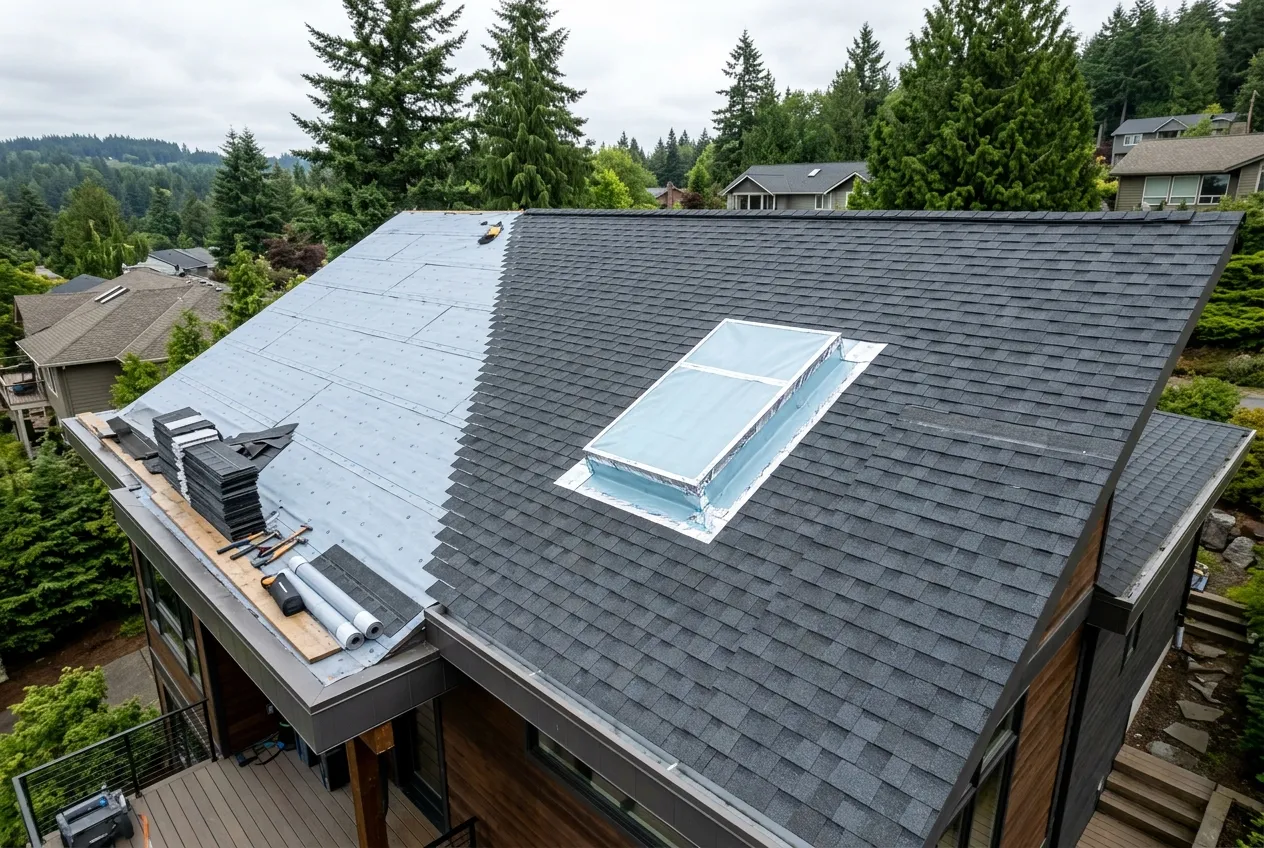
Skylights. Every skylight is a hole in the roof. The manufacturer sells a flashing kit engineered for that unit and that roof covering, and it should be used. See our note on this in skylight installation and replacement cost.
Pipe penetrations. Plumbing vents come through the roof with a boot around them. On most Pacific Northwest homes this is the single most likely thing to be leaking right now, for a specific reason covered below.
Drip edge at eaves and rakes. Directs water off the deck and into the gutter instead of behind it.
The pipe boot problem
If you have an unexplained ceiling stain, look at the plumbing vents first.
The traditional pipe boot is a metal flange with a rubber or neoprene collar that seals against the pipe. The metal lasts decades. The rubber does not. UV degrades it, it hardens, it cracks around the top of the collar, and water runs straight down the outside of the pipe into the attic.
The service life of that rubber is commonly well short of the shingles around it, which means a roof can be perfectly sound at fifteen years and leaking at three separate pipe boots. It is one of the most common repairs we do and one of the cheapest, provided it is caught before the decking around it rots.
Look for a collar that is cracked, split, or pulling away from the pipe. From the ground with binoculars is often enough.
Why reused flashing is the corner not to cut
On a re-roof, flashing is a real cost. It is also the item most often quietly reused to make a bid competitive.
The logic sounds reasonable: the metal looks fine, why replace it. The problem is that flashing is not a standalone part. It is woven into the shingle courses, and its performance depends on that integration. Pulling new shingles around old flashing means the layering is compromised at exactly the point where water concentrates.
The other issue is age matching. If the flashing is as old as the roof you just removed, it is now the oldest component on a new roof, and it will fail first - typically five to ten years in, which is well inside the warranty period on the shingles and not covered by it, because the shingles are fine.
When you compare estimates, ask each bidder explicitly what happens to the chimney flashing, the wall flashing and the pipe boots. The answers will differ, and that is often where a price gap comes from. It is one of the itemized things we suggest checking in roof replacement cost in Vancouver, WA.
Caulk is not flashing
Sealant has a place: bedding counter-flashing into a masonry reglet, sealing fastener heads, small detail work.
It is not a substitute for correctly lapped metal. Caulk has a service life measured in a few years outdoors. Flashing has one measured in decades. Any repair whose entire strategy is a bead of sealant is a repair with an expiration date, and on a Pacific Northwest roof that date arrives during the wet season.
If someone “fixed” your chimney leak with a tube of roof cement, that is a temporary measure whether or not it was described as one.
Why the leak is never where the stain is
Water travels. It comes through a flashing failure, runs along the top of a rafter or the underside of the deck, and drops through the ceiling somewhere else entirely. A stain in the middle of a bedroom can originate at a chimney fifteen feet away and uphill.
This is why chasing a leak from inside rarely works, and why we start in the attic with a light, following the track back up to the entry point, before going on the roof.
What you can check yourself
From the ground with binoculars:
- Pipe boots: cracked or lifted rubber collars
- Chimney: rust, gaps, or visible sealant smears at the base
- Valleys: debris packed in, or exposed nail heads
- Any place a roof meets a wall: exposed sealant instead of metal
From inside the attic, on a dry day with a flashlight:
- Dark streaks running down rafters
- Staining on the sheathing, particularly around chimneys and vent pipes
- Daylight anywhere it should not be
Water stains that are dry and old are a leak that was fixed or a leak that only happens with wind-driven rain from one direction. Both are worth knowing about.
Getting it looked at
Roof repair at the flashing is among the least expensive roof work there is when caught early, and among the most expensive when they are not, because by then the decking and sometimes the framing has gone.
We do free inspections across Clark County and document with drone photography, which means the chimney and the valleys get looked at properly rather than guessed at from the driveway.