

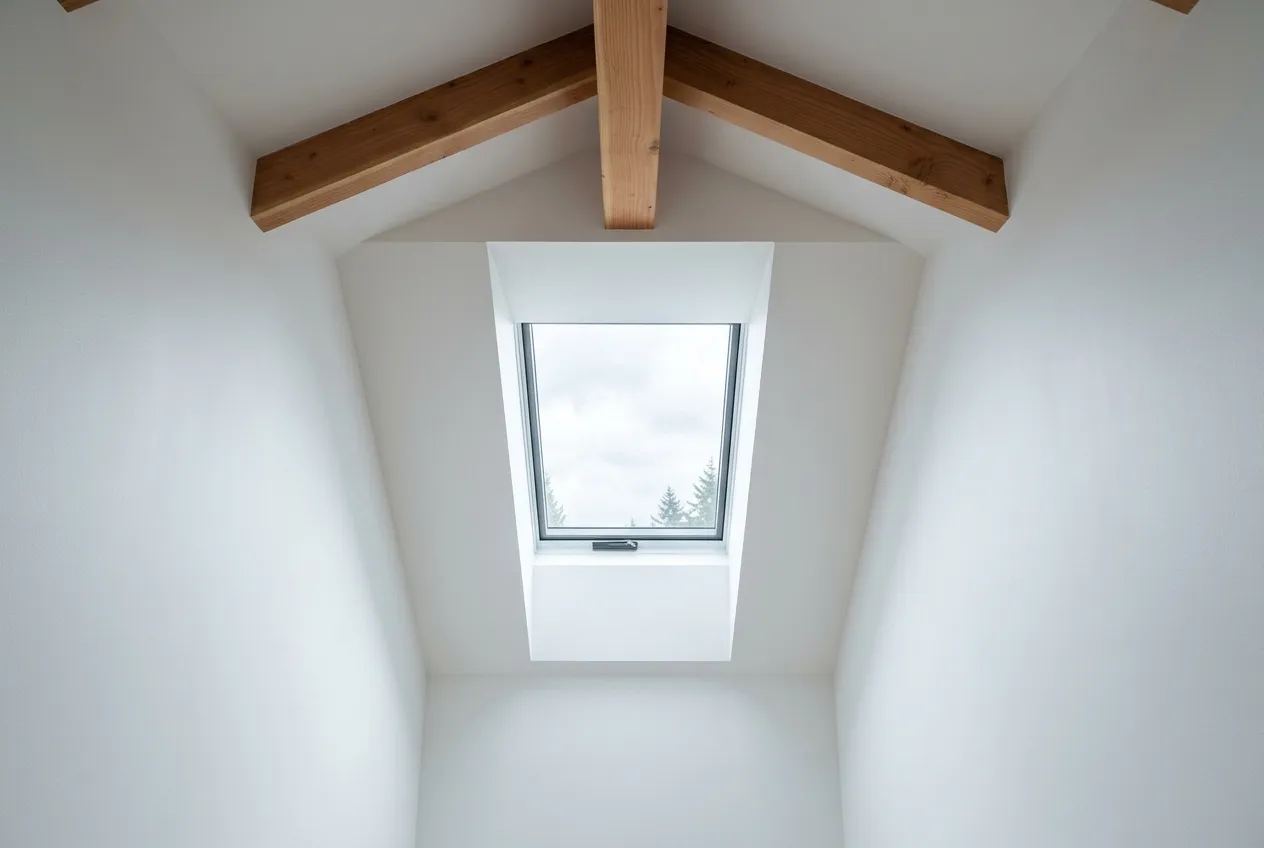
Skylight pricing confuses people because the unit itself is a modest share of the job. What you are really paying for is a controlled hole in a roof, flashed so it never leaks, plus a finished shaft on the inside.
Timing is the biggest lever
If you are re-roofing anyway, add or replace skylights then. The roof is open, the crew is already on it, the shingle field is being installed fresh around the unit, and the flashing kit integrates into new material rather than being woven into an existing roof.
Done as a standalone project later, all of that has to be created from scratch: cut into a sound roof, remove and replace surrounding shingles, weave in flashing, and hope the existing material still matches. It is substantially more expensive for the same finished result.
If your roof has five to seven years left and your skylights are original, that is the conversation to have now rather than the week the roof gets replaced.
Deck-mount or curb-mount
Deck-mount units sit low against the roof plane and use a manufacturer flashing kit engineered for the specific unit and roof covering. On an asphalt shingle roof this is the lower profile and generally the better-looking install.
Curb-mount units sit on a built-up wooden curb. They are the right answer on low-slope roofs, on some replacements where an existing curb is sound, and where the roof covering does not suit a deck-mount kit.
Replacement is usually cheapest when the new unit matches what is already there, because the existing opening and, on a curb-mount, the existing curb can be reused.
Fixed, vented, or solar
A fixed unit is glass that does not open, and it is the least expensive and the least likely to ever leak because it has no moving parts.
A vented unit opens, which matters in bathrooms and kitchens where the point is moisture as much as light. Manual crank versions cost less than motorized. Solar-powered venting units cost the most, need no wiring run, and in the US the solar units and their installation have historically qualified for a federal residential clean energy credit. That is a tax question rather than a roofing one, and it changes with legislation, so confirm current eligibility with your tax preparer rather than taking a roofer’s word for it.
The shaft is half the job
This is the part homeowners do not picture. Between the roof deck and the ceiling there is an attic, and light has to travel through it. That means framing a shaft, insulating it, drywalling it, taping, texturing and painting.
A skylight in a vaulted ceiling has essentially no shaft and is the simplest case, which is why the custom homes in Camas and Felida are usually cheaper to add one to than a single-story rambler in Orchards. A skylight in a single-story house with a deep attic can have a shaft several feet long, and the drywall and finish work in that shaft is a meaningful share of the total.
Ask any bidder where the interior finish work stops. Some quotes end at “we install the unit and leave a framed opening,” which leaves you hiring a drywall finisher and a painter.
Sun tunnels are a different product
If the goal is daylight in a windowless hallway, closet or interior bathroom, a sun tunnel is usually the better value. It is a reflective tube from a small roof dome to a ceiling diffuser, needs no framed shaft, and installs far faster because it threads between rafters rather than cutting them.
It does not give you a view of the sky and it does not open. If what you want is light rather than a window, that is fine.
It is also the only option that works on a heavily shaded lot. Winter sun here sits low, and a mature stand of fir on the south side blocks that angle outright, so enlarging a wall window facing those trees enlarges the view rather than the light. Going up through the roof reaches open sky instead, which is most of why daylight work in La Center happens on the roof rather than the wall.
Why the leak reputation exists
Skylights have a reputation for leaking, and the reputation was earned by bad installs rather than by the product. Almost every leaking skylight leaks at the flashing, not the glass.
That is why we treat skylights as roofing work done by the roofing crew, with the manufacturer’s flashing kit matched to the roof covering. A unit set into a roof and sealed with caulk will leak, on a schedule. We wrote about the underlying principle in roof flashing and where leaks actually start.
An old acrylic bubble skylight that has yellowed and crazed is a different matter. Those do fail at the dome, and by the time they are cloudy they are usually near the end of their service life.
Why no published price
The spread between a like-for-like curb-mount replacement during a re-roof and a new deck-mount unit with a six-foot finished shaft in an existing roof is large enough that a single published figure would misinform most readers.
We quote skylight work per opening, tell you whether the roof timing changes the number, and say clearly where the interior finish work ends.
Quality Master is a Velux installer working across Clark County, doing deck-mount and curb-mount units, sun tunnels, and re-flashing on existing skylights during roof replacements.