

Skylights have a bad reputation in the Pacific Northwest, and it is mostly undeserved. We take a lot of leaking-skylight calls between November and March, and in most of them the skylight itself is watertight. Something around it failed, or nothing failed at all and the homeowner is looking at condensation.
First: is it a leak or is it condensation?
You can usually make this call from inside the house without a ladder.
Condensation shows up on the glass itself. You will see beading or a film on the inside pane, and the water runs down the glass into the frame channel at the bottom. It happens on clear cold nights, not necessarily during rain, and it is worst over kitchens, bathrooms and laundry rooms. A skylight is the coldest surface in the room, so it is where humid indoor air gives up its moisture first.
A real leak shows up during rain, especially wind-driven rain from one direction, and it stains the drywall or trim of the light shaft rather than sitting on the glass. Brown ring-shaped stains at the upper corners of the shaft are the classic signature. Water that appears hours after the rain stopped also points to a leak, because it has been traveling.
If it is condensation, the fix is ventilation and humidity control, not roofing. Run the bath fan longer, and check that the attic is vented well enough that the skylight shaft is not sitting in a moisture pocket.
The flashing kit, or the absence of one
This is the leading cause by a wide margin. Every major manufacturer sells a flashing kit engineered for that unit and that roof covering, with a head flashing, sill pan and step pieces that interleave with the shingle courses. Installed correctly, water never touches sealant.
What we find instead, on a lot of older installs around Hazel Dell and Minnehaha, is a unit dropped into the opening and sealed around the perimeter with roofing cement. That works for about five years. Then the sealant shrinks, cracks and pulls away from either the metal or the shingle, and there is a continuous path into the roof deck.
Caulk is a gasket, not flashing. Its service life is measured in seasons.
It is not only an old-house problem. Units installed during original construction go in on a builder’s schedule, and the flashing detail is exactly the sort of fiddly work that gets rushed when a crew is behind - the consequence surfaces about a decade later. That is why so much of our skylight and window work in Ridgefield is re-flashing rather than replacement, on units still inside their manufacturer warranty. Replacing a sound skylight because the flashing failed is the expensive answer to the wrong question.
Rot in the curb underneath
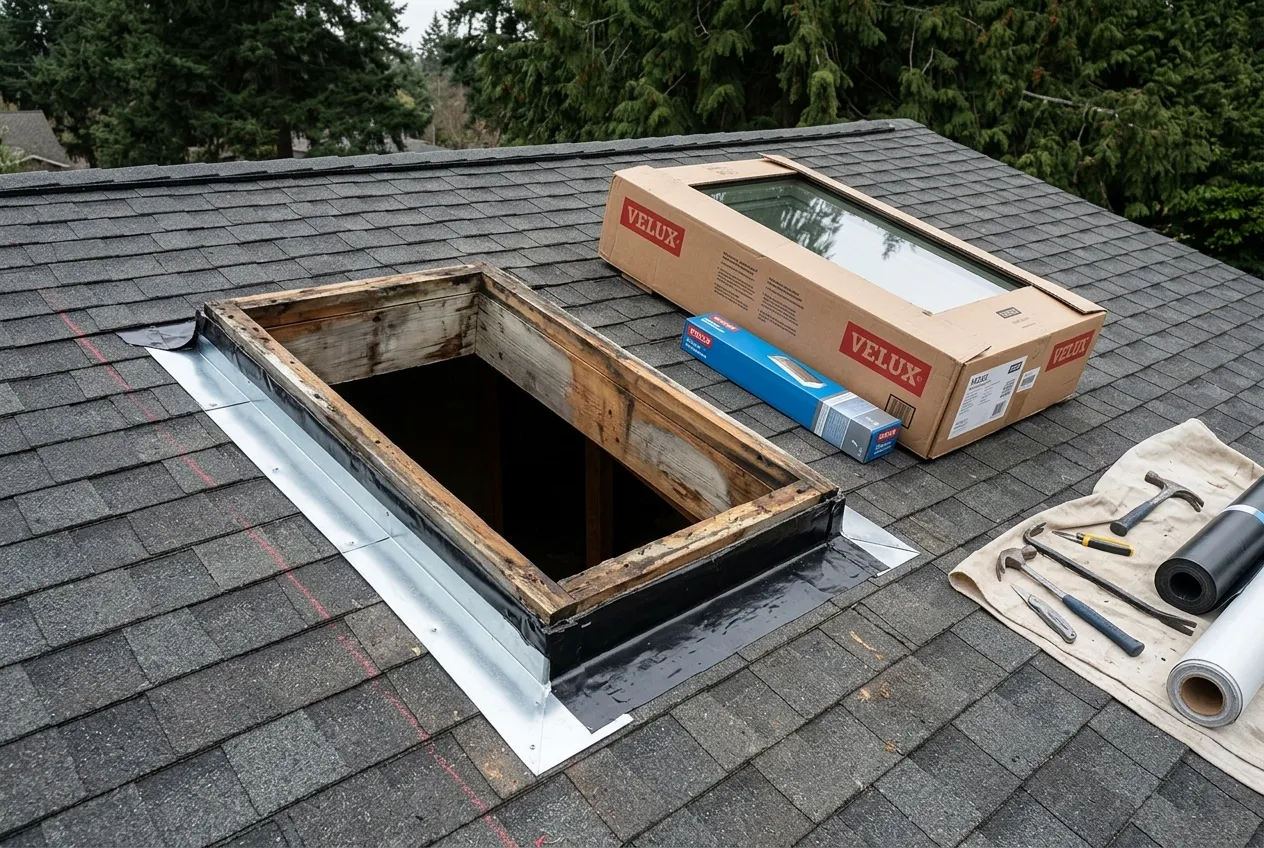
Older skylights sit on a built-up wood curb. Once water has been getting past the flashing for a few winters, the curb is the first thing it finds. A rotted curb no longer holds fasteners, the unit shifts fractionally, and the leak accelerates from there.
This is why a leak that looked small can turn into a larger scope once the shingles come off, and why we open things up and look before quoting a repair rather than after.
A blown seal in the glass
Insulated glass has two panes with a sealed gas-filled gap. When that perimeter seal fails you get permanent haze between the panes and often a slow weep at the frame. That is not repairable, and on a unit past twenty years the seal and the gaskets usually reach the end together.
What is happening uphill of the unit
Water runs downhill, and a skylight is an obstacle in its path. Fir and cedar needles pile up on the upslope side and form a dam, moss colonizes the wet spot that dam creates, and the shingles just above the head flashing stay saturated all winter.
Eventually the leak is not at the skylight at all. It is several feet above it, and the skylight is simply where the water becomes visible. On the heavily canopied lots in Felida and Hockinson this is the most common version of the problem we see. Keeping the upslope side clear and staying ahead of moss on the surrounding shingles does more for a skylight than anything you can do to the unit itself.
It is also worth knowing that flashing failures follow the same logic everywhere else on the roof. Our piece on where roof leaks actually start covers the chimneys, valleys and pipe boots that fail for the same reasons.
Re-flash it or replace it
The decision comes down to the age of the unit and the condition of the curb.
Re-flash when the unit is reasonably young, the glass is clear with no fogging between panes, the gaskets are still pliable, and the curb framing is sound. We strip the shingles around the opening, install a proper manufacturer flashing kit, weave the shingles back in, and the repair is watertight even though the roof around it is older. That is typically a half-day.
Replace the unit when the glass has fogged, the frame is an older acrylic bubble, the gaskets have gone hard, or the curb needs rebuilding. Once we are opening the roof and rebuilding framing, the labor gap between a re-flash and a full replacement is small, and putting a twenty-year-old unit back into a fresh opening is work you pay for twice.
One thing worth knowing about modern replacements: deck-mount units sit flush in the roof plane with low-profile flashing and read considerably cleaner than the curb-mount units they usually replace. If your existing skylight sits up on a visible box, a swap changes the look of the roof, not just the leak.
When to bundle it with the roof
If your roof is within a few years of replacement, wait and do the skylights with it. Not because the leak will keep, but because the economics are lopsided.
A standalone skylight replacement requires opening and reclosing the shingle field around the unit, and that is most of the labor. During a re-roof the field is already open, so the same work folds into a job that was happening anyway. What drives the difference is access, not the unit.
The reverse holds too. If the roof has ten good years left, do not let anyone talk you into replacing it because a skylight leaks. Re-flash the skylight and revisit the roof on its own timeline. Our guide to reading the end of a roof’s service life covers how to tell where yours stands.
Getting it diagnosed
A stain on a skylight shaft tells you water got in. It does not tell you where. We inspect and diagnose skylight leaks and re-flashing at no cost, and we will tell you straight whether you need a flashing kit or a new unit.