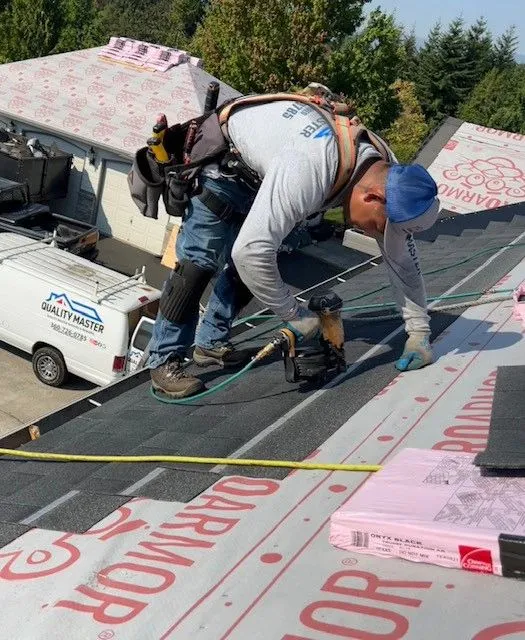
Pacific Northwest windstorms aren’t gentle. A typical winter low pressure system over Clark County, WA can push sustained 30-40 mph winds with gusts to 60+, and once every few years we get a real event - the 2021 winter storm tore shingles off thousands of Clark County roofs. If you’ve just been through one and your roof took damage, Quality Master Roofing & Remodel recommends the following for the first 24 hours, the first week, and the insurance process that follows.
First 24 hours: stop the bleeding
Document before you do anything else
Take photos. Lots of them. From the ground, from a phone held over your head, from a second-floor window if you have one. Include wide shots of the whole house, medium shots of each elevation, and close-ups of any visible damage. Time-stamp them by enabling camera location and timestamp metadata. These photos are the foundation of every insurance claim.
Tarp it if there’s an active leak
If water is coming into the house, you need a tarp on the roof. Don’t climb up yourself in the wind or rain - Vancouver, WA roofs are wet, slick, and tarp work in poor weather sends people to the ER every winter. Call a roofer. Quality Master does emergency tarping across Clark County; we usually get there same day for active leaks. If you must do something immediately, place buckets under interior leaks and move belongings out of the affected room.
Don’t touch the debris on the ground (yet)
Shingles or shake pieces in your yard are evidence. If your adjuster wants to see them, you don’t want them already in the trash. Take photos, bag them, set them aside.
Watch out for storm-chaser contractors
After a major Clark County windstorm, out-of-state contractors flood the area. They knock on doors offering “free roof inspections,” promise to “handle the insurance for you,” and disappear after collecting the deposit or the insurance check. They’re not licensed in Washington, they don’t pull permits, and there’s no one local to call when the workmanship fails in two years.
Two simple rules: only work with a contractor licensed in Washington State (look them up at L&I’s contractor verification), and never sign anything that hands the insurance check directly to the contractor - that’s called an Assignment of Benefits, and it’s how homeowners lose control of the claim.
Working with your insurance company
Call your insurance, then call us
File the claim with your insurer - they’ll assign you an adjuster who will come out to inspect. Call Quality Master Roofing & Remodel before that visit. We’ll come out for free, document the damage with drone photos, and write up a scope of work. When the adjuster arrives, we can meet them on-site and walk the roof together. Adjusters generally appreciate this; it speeds up the process and reduces disagreement about scope.
Understand the difference between ACV and RCV
Most homeowner policies pay out in two phases:
-
Actual Cash Value (ACV): The depreciated value of the damaged roof. Paid up front so you can begin work.
-
Recoverable Cash Value (RCV): The depreciation amount, released after the work is complete and you submit the final invoice.
You’ll need to actually complete the work and submit documentation to recover the full claim. If a contractor offers you a deal at the ACV-only amount and “saves” you the extra paperwork, they’re saving themselves money - by cutting corners on the scope your insurance paid for.
Code upgrades and “matching”
If the storm damaged half a roof, Washington insurance regulations generally require the insurer to pay for replacement of the entire slope so the new shingles match. Don’t let an adjuster talk you into a patch repair on a 15-year-old roof where the new shingles won’t match the old. That’s a documented argument worth having.
Code upgrades - like new ice & water shield required by current code that wasn’t required when the original roof was installed - are typically covered if your policy includes Ordinance & Law coverage. Check your declarations page.
Repair vs. replace after storm damage
Some storm damage is genuinely localized - a few shingles off a ridge, one section of flashing - and a repair makes sense. But “matching” is a real challenge: shingles fade over time and a 5-year-old patch is visibly different from the surrounding roof. If insurance is paying, often the cleaner outcome is a full slope replacement, not a patch.
For roofs over 15 years old that take significant storm damage, the math usually favors replacement. The insurance pays for the damaged portion; you pay the gap for the rest, but you get a brand-new roof with a full warranty instead of a patched-together old one.
Quality Master handles the whole process
We handle storm damage roof repair and insurance claims all the time across Clark County, WA - Vancouver, Camas, Washougal, Battle Ground, Ridgefield, and beyond. From the first phone call after the storm, through the adjuster meeting, the work itself, and the final RCV submission, we handle the documentation. Homeowners deal directly with Victor and the crew - not a call center, not an out-of-state storm chaser. We pull the permit, do the work to code, and stand behind it.