

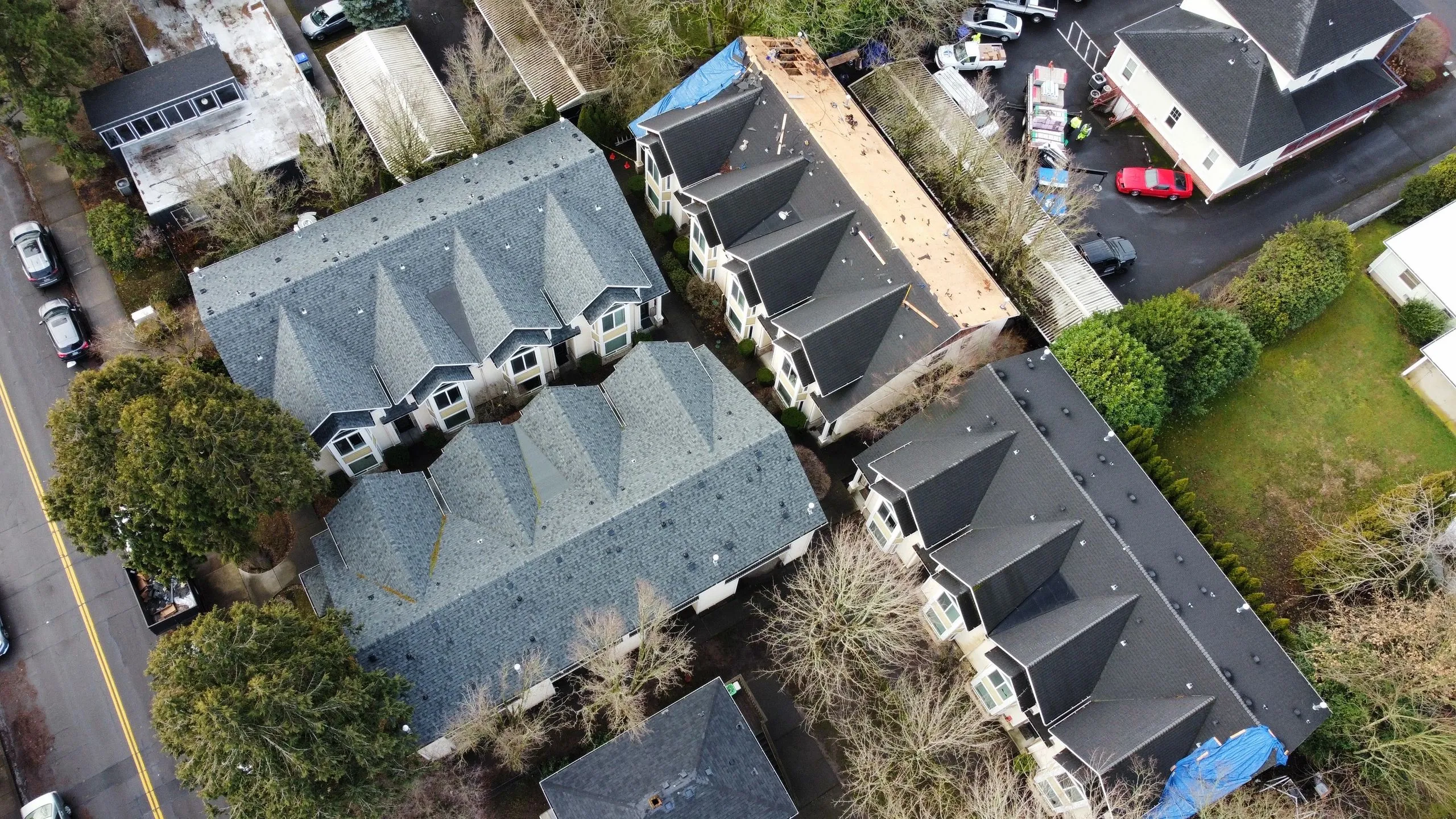
Homeowners ask whether a re-roof really needs a permit, usually because someone has offered to do the job cheaper without one. It is worth understanding what the permit is actually for before treating it as paperwork.
Does a re-roof need a permit in Clark County?
Yes, in most cases. Replacing a roof covering is regulated work in Clark County and in its incorporated cities, and it requires a permit.
Jurisdiction matters. A house inside Vancouver city limits is permitted through the City of Vancouver, and a house in unincorporated Clark County goes through Clark County Community Development. Camas, Washougal, Battle Ground, Ridgefield and La Center each run their own. Requirements and fees are broadly similar and the details differ, which is one reason it should be the contractor’s job rather than yours.
Minor repair work generally does not require a permit. Replacing a few storm-damaged shingles or a failed pipe boot is maintenance. The line is roughly between repairing a roof and replacing a roof covering, and where exactly that line sits is a question for the jurisdiction.
Always confirm current requirements with the permitting authority directly. Codes and thresholds get amended, and a blog post is not the authority on your specific address.
What the permit is actually enforcing
Three things that matter to you as the homeowner.
The layer limit. Washington’s adopted code limits how many layers of roof covering can be on a structure, and a new layer cannot go over existing material in defined circumstances - including where the existing roof is water-soaked or deteriorated, or where the deck below cannot be inspected. In practice this is what prevents a third layer going on a house that already has two, which is a structural load question as well as a roofing one.
Sheathing condition. An inspection means somebody other than the contractor has looked at whether the deck was sound before it got covered up. This is the requirement that protects you from a crew shingling over soft plywood.
Ice barrier and underlayment requirements where they apply, along with fastening and flashing standards.
None of that is bureaucratic. It is the specific list of things that go wrong on a cheap re-roof, which is why they are what gets inspected.
What the process looks like
For a straightforward residential re-roof:
- The contractor applies, usually over the counter or online, with the scope and the property information.
- The permit issues, often quickly for a like-for-like re-roof with no structural work.
- The work is done.
- An inspection is scheduled and performed.
- The permit is finaled and the record closes.
Structural changes - adding a dormer, changing to a materially heavier covering such as tile, altering the framing - trigger plan review and take longer. Switching to a heavier covering is the one homeowners do not anticipate: the framing may need evaluation for the additional dead load.
The permit should be on your estimate
A permit has a cost, and it belongs on the written estimate as a line item. If you are comparing bids and one is noticeably cheaper, check whether the permit is in it. That is one of the standard omissions, along with flashing and ventilation, that makes a bid look competitive without describing the same job. We list the others in roof replacement cost in Vancouver, WA.
Why the contractor should pull it, not you
Some contractors ask the homeowner to pull the permit as owner-builder. Be careful with this.
When you pull the permit, you take on the responsibility for the work meeting code. If there is a defect later, the record shows you as the responsible party, and it can complicate both warranty claims and any dispute with the contractor.
A licensed contractor pulling the permit under their own license is the normal arrangement, and a request to do it the other way is worth asking about directly. Sometimes the answer is innocuous. Sometimes it means the contractor is not licensed to pull it, which you can check yourself through the Washington State Department of Labor & Industries contractor lookup.
What unpermitted work costs you later
It rarely surfaces immediately. It surfaces at resale.
A buyer’s agent or inspector notices a roof that is obviously newer than the permit record. That becomes a disclosure question, a negotiating point, and sometimes a demand for retroactive permitting - which can mean opening up finished work so an inspector can see what is underneath. That is far more expensive than the original permit.
Insurance is the other exposure. A carrier investigating a claim on a roof that was replaced without a permit has grounds to ask questions about whether the work met code, which is a conversation you do not want during a claim. See does homeowners insurance cover roof replacement.
Decks, while you are here
Different threshold, commonly confused with the roofing one. In Clark County and its incorporated cities, a deck more than 30 inches above grade requires a permit with footing and framing inspections. Details in what a deck costs to build in Clark County.
How we handle it
On every roof replacement we pull the permit under our license, schedule the inspection, and hand you the finaled record along with the manufacturer warranty registration at the end of the job. Both of those are documents you will want if you ever sell the house, and both are commonly missing on cheap work.
Quality Master is licensed in Washington (QUALIML786JF) and Oregon (CCB 243945), bonded and insured, and you can verify all of that yourself in about a minute before you sign anything.