

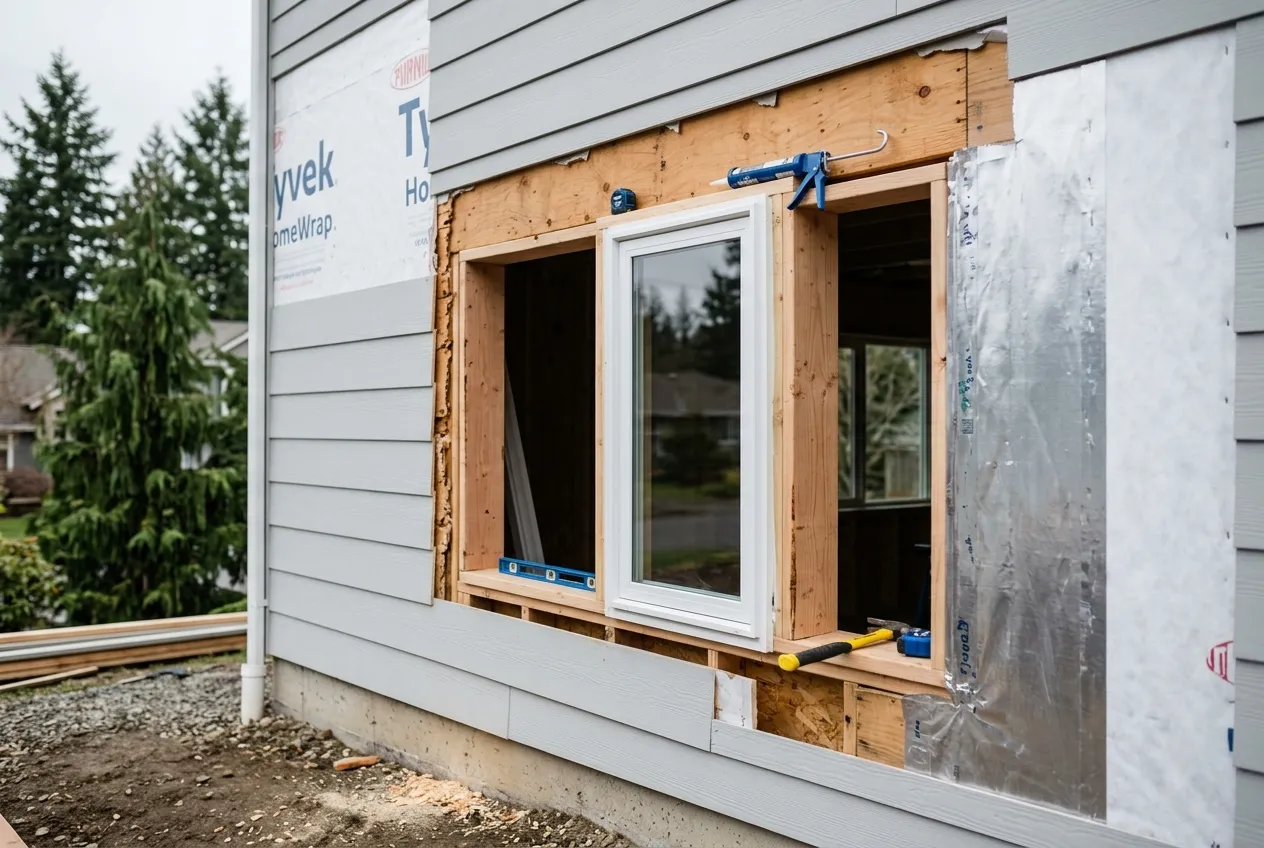
Water on an interior windowsill makes the window the obvious suspect. But the visible wet spot does not establish whether the problem is the window itself, its installation, the siding around it, or a detail farther up the wall.
If a window leaks when it rains, photograph the area and arrange an assessment before ordering a replacement unit or covering every exterior joint with sealant. A useful investigation considers how the siding and surrounding wall details meet the opening, as well as the window.
Record when the water appears
Write down the date, affected room, and where moisture first becomes visible. Does it collect on the sill, run down the trim, appear at an upper corner, or show as a stain below the opening? Does it occur whenever it rains or only with weather from a particular direction?
Take both a wide photograph and a close-up from indoors. From a safe location outside, photograph the whole wall so the contractor can see the roofline, siding, trim, and features above the window. Do not climb onto a wet roof or lean out of an upper-story opening to get a better picture.
Tell the contractor about recent changes: new siding, a replaced window, a repaired roof, a deck attachment, or an exterior fixture installed nearby. That history gives the inspection a starting point without deciding in advance which trade caused the problem.
Separate rain entry from other moisture concerns
Not every wet window has the same source. Moisture on a room-side glass surface, moisture between panes, and water appearing at trim during rain are different observations. Our guide to foggy windows and condensation explains why identifying the location matters.
Avoid describing all of those conditions as “a failed seal” when requesting an estimate. Instead, say exactly what you see and when. A contractor can then decide which checks are needed and whether the concern fits the proposed work.
If water is actively entering, move belongings away when you can do so safely and keep away from wet electrical devices or outlets. Document the condition and arrange prompt help. Cosmetic repairs can wait until the source has been investigated.
Look at the opening as part of the wall
The exterior surface, flashing, and water-management layers must work together around an opening. James Hardie’s lap-siding installation guidance describes flashing as a way to direct water back out at siding joints. The broader inspection question is how the relevant details on your house actually connect.
Ask the contractor to examine the area above and beside the affected window, not only the visible interior stain. Missing or damaged components, prior repairs, and the relationship between adjacent materials may matter. Some of those conditions cannot be confirmed without opening a portion of the assembly.
For a home in Washougal, share any pattern associated with wind-driven rain. For an older exterior in Minnehaha, provide whatever you know about prior window and siding replacements. Those are useful site histories, not a diagnosis based on location.
Do not make a blanket caulking plan
Sealant belongs in certain details, but a wall also needs the drainage paths intended by its design and product instructions. Filling every visible gap can be the wrong response. The correct treatment depends on the materials and the specific joint.
Ask which joints need maintenance, which details need repair, and whether the investigation found a concealed issue that a surface treatment would not address. If a proposal consists only of adding sealant, ask what evidence supports that as the repair for the observed leak.
Avoid pressure-washing the area as a test or trying to seal an upper opening from a ladder in wet conditions. A controlled investigation should be planned by the contractor, with attention to where water is introduced and what can be observed.
Compare a window repair with surrounding work
If window replacement is recommended, ask why the unit itself needs replacement and what installation details will be addressed at the same time. Replacing glass or a sash is a different scope from removing the full frame and integrating the opening with the surrounding wall.
If siding must be opened, discuss how it will be reinstated, whether materials can be matched, and who handles interior finishes. Clarify how additional concealed damage will be documented and approved. The estimate should make those responsibilities visible before the opening is exposed.
Keep the repair tied to the evidence
Ask for photographs, a written explanation of findings, and the proposed sequence of work. After completion, save the record and note what happens during later rain. Report any recurrence with the same specific observations you gathered at the start.
Contact Quality Master Roofing & Remodel with photos of the window, the wall outside, and the timing of the leak. That gives the assessment a better foundation than guessing which product needs to be replaced.