

Siding is the exterior project where estimates diverge the most, because a siding job is really two jobs: the cladding you can see, and the envelope work behind it that you cannot. Bids that only price the first one always look cheaper.
Here is what actually drives the number in Clark County.
Wall area, openings, and stories
Siding is quoted by wall area with deductions for openings, and a two-story house costs more per square foot than a single-story one for the same reason a steep roof does: staging. The crew spends time setting up and moving scaffolding that they do not spend on a rambler.
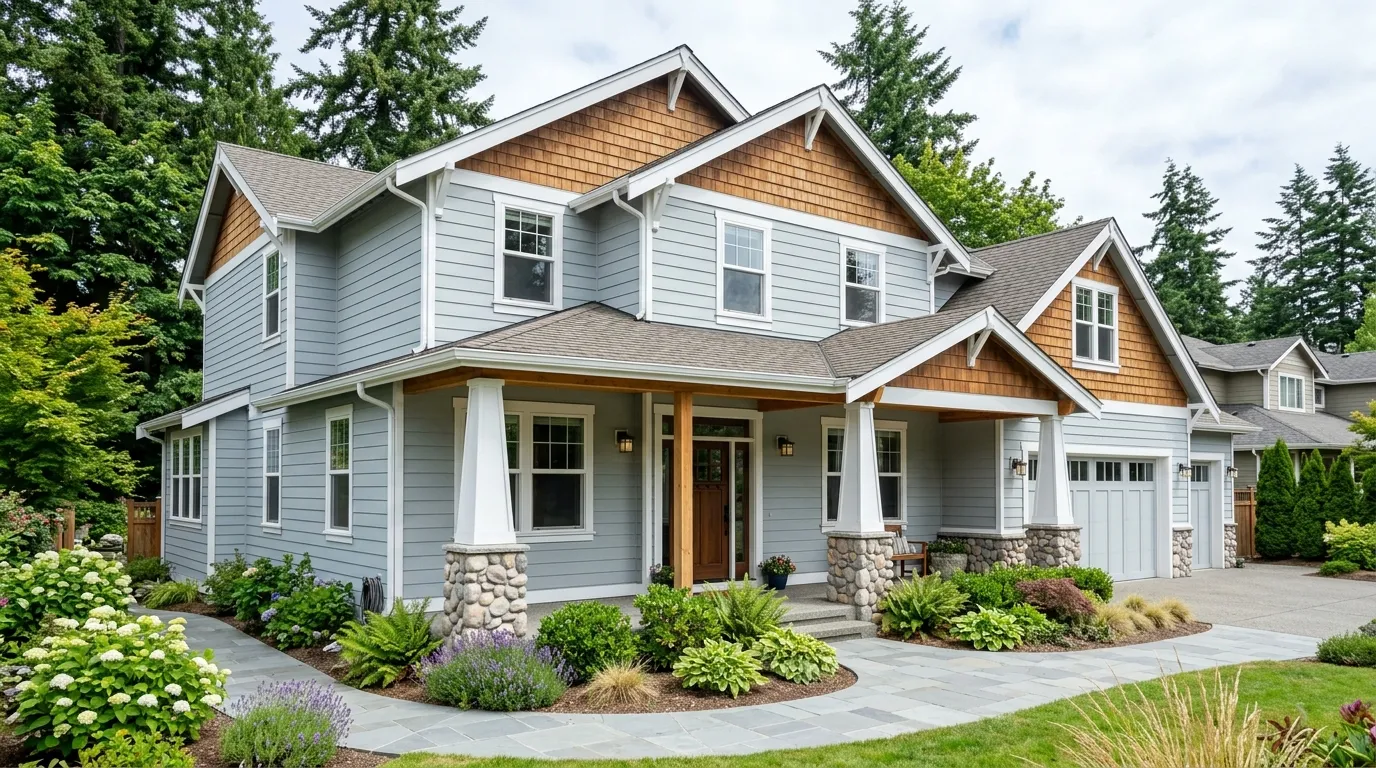
Houses with a lot of articulation cost more too. Every bump-out, gable return, dormer and corner is a cut, a corner detail, and a place water has to be kept out of. A simple box with four walls is the cheapest shape to side and a Craftsman with three gables and a wrapped porch is not.
The material, and why it is not the main event
Homeowners usually start here and it is genuinely the smallest lever of the five.
- Vinyl is the entry point. Fast to install, no painting, and it does fine in this climate as long as the installation allows for expansion.
- Engineered wood (LP SmartSide) sits in the middle, takes paint well, and handles impact better than fiber cement.
- Fiber cement (James Hardie) is the premium of the three, is non-combustible, and holds a factory finish for a long time in wet weather.
- Cedar is usually a repair-and-match situation in Clark County rather than a full re-side, and it carries a maintenance cycle the others do not.
We compare two of these directly in LP SmartSide versus James Hardie, and there is an existing comparison of James Hardie versus vinyl siding if you are weighing the two ends of that range.
The reason material is not the main event: the labor to remove old siding, correct what is behind it, and detail the new cladding properly is similar regardless of which product goes back on. Switching from Hardie to vinyl saves less than most people expect, because the expensive part of the job is not the box the siding came in.
Trim, fascia, and corners
This is where bids quietly separate. Siding meets trim at every window, door, corner, roofline and transition, and those details are where water gets in.
A quote that re-sides the field and reuses the existing trim is a different scope from one that replaces the trim with the siding. If the trim is old cedar that has been painted six times and is soft at the bottom edge, reusing it means the new siding is detailed into rotting wood. Ask each bidder explicitly what happens to the trim, the corner boards and the fascia.
Window and door flashing
Whether windows get properly wrapped and re-flashed during the re-side is the highest-consequence line item on the estimate and the easiest one to leave off.
The moment the siding is off, the window flanges and the weather-resistive barrier are exposed and accessible. That is the one opportunity to correct a decade of bad flashing detail for a fraction of what it costs to do later. If your windows are also near end of life, doing window replacement during the re-side is meaningfully cheaper than doing them as two separate projects, because the opening only gets opened once.
What is behind the old siding
Same principle as decking under a roof: nobody knows until it comes off.
In Clark County the recurring finds are rot at the bottom course where siding was installed too close to grade, soft sheathing under windows that were never flashed correctly, and water damage on the north and west elevations that took the weather. Pre-1980 homes in Minnehaha and Hazel Dell turn up this kind of thing regularly.
A good estimate tells you the rate for sheathing replacement and rot repair before the work starts, so an unpleasant discovery is a known cost rather than a renegotiation.
Age changes what is likely back there, and it is the single biggest swing in a quote. Walls on pre-1940 Portland homes often have no drainage plane at all, sometimes no sheathing behind the cladding. At the other end, a fifteen-year-old house rarely needs replacing: what we find on newer Ridgefield subdivisions is usually an installation defect worth a few hundred to correct.
Why we quote instead of publishing a rate
A per-square-foot siding price would be misleading for almost everyone who read it. The same 1,800 square feet of wall is a straightforward job on a single-story rambler with aluminum-wrapped trim and a complicated one on a two-story with three gables, original cedar trim, and fourteen windows that need re-flashing.
So on every siding replacement we measure the walls, count the openings, tell you what we intend to do with the trim and the window flashing, and state the rot-repair rate up front. Then the number means something.
What to ask every siding bidder
- What is the wall area you measured, and how did you handle openings?
- Is the trim being replaced or reused? What about corner boards and fascia?
- Are windows being re-flashed and wrapped, or is the siding being cut to the existing trim?
- What is the rate for sheathing and rot repair if you find it?
- What weather-resistive barrier goes on, and how are penetrations sealed?
Quality Master is a James Hardie certified installer working across all of Clark County. We handle the whole envelope - siding, trim, corners and fascia - rather than the field only, because that is where siding jobs succeed or fail.