This question comes up on almost every gutter estimate, usually phrased as which one looks better. It is worth answering both ways, because the appearance answer and the performance answer sometimes point in opposite directions and performance should win.
In the trade these are often called 5K and 6K. The K refers to the K-style profile, the ogee shape that looks like crown moulding from the ground. The number is the width across the opening.
What looks better
On most Clark County homes, the 5-inch reads as correct because it is what the eye is used to. It sits in proportion to standard fascia and does not draw attention.
The 6-inch is visibly chunkier. On a large house with wide fascia, tall walls or a substantial roof, it looks appropriate and can look better, because a 5-inch on a big roof plane looks undersized. On a small single-story cottage with narrow trim it can look heavy and slightly commercial.
The honest summary: on a big house 6-inch looks better, on a small house 5-inch looks better, and on the majority of houses in between most people would not notice unless the two were side by side.
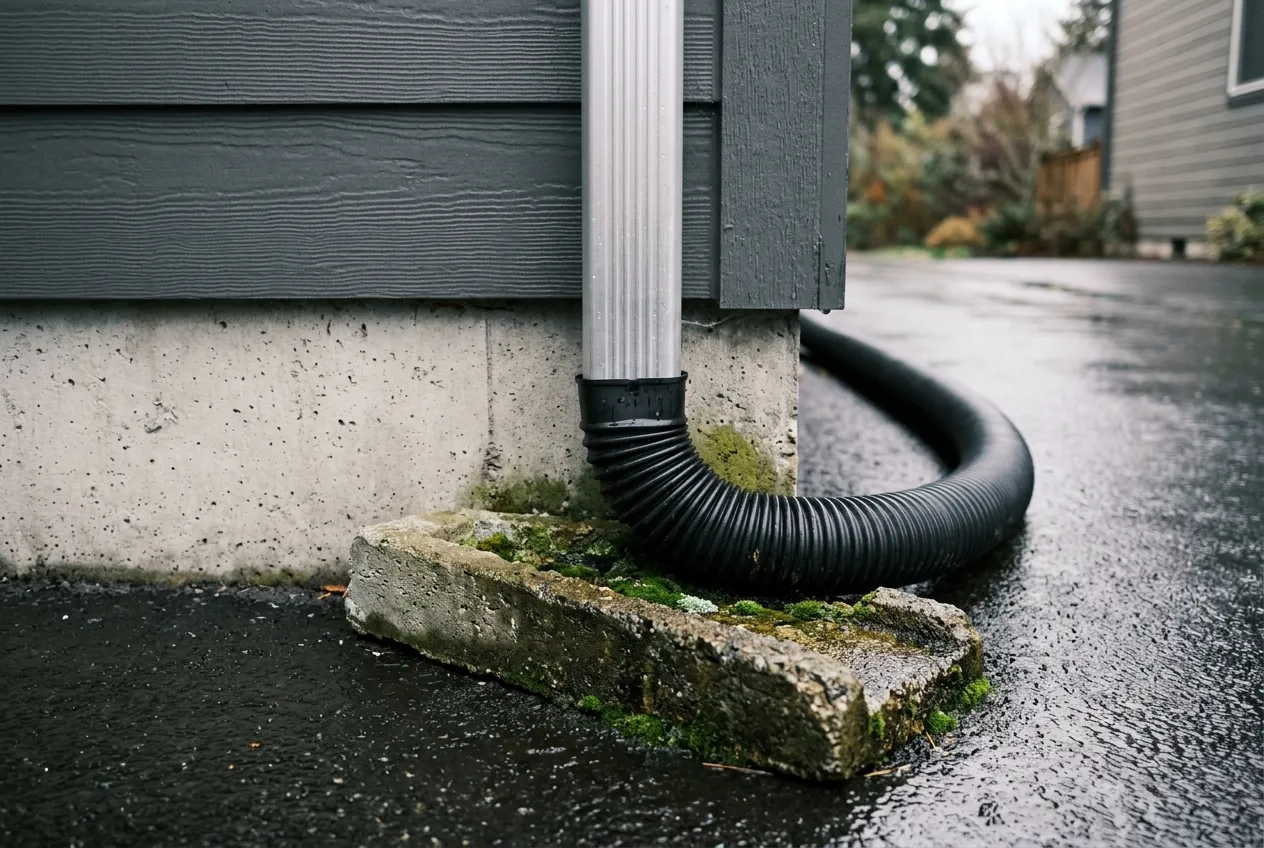
Downspouts follow the gutter. A 5-inch typically pairs with a 2x3 downspout and a 6-inch with a 3x4, and the larger downspout is more visible on the wall than the gutter is at the eave.
What actually performs better
Capacity is not close. The 6-inch profile carries roughly 50% more water, and the 3x4 downspout that goes with it moves substantially more than a 2x3. That downspout difference matters more than people realize, because in the Pacific Northwest gutters usually fail to keep up at the outlet rather than along the run.
Four situations where we recommend 6-inch without hesitation:
Steep roofs. This is the big one. Water leaves an 8/12 or 10/12 pitch with velocity, and at the eave it can shoot straight over a 5-inch gutter. Homeowners read that as a gutter that is not working, and it is really a gutter that is too small to catch what is being thrown at it. The hillside and custom homes in Camas, Felida and Hockinson are the usual candidates.
Long unbroken eave runs. A 40-foot run collects a lot of water before it reaches an outlet. More capacity along the run buys margin.
Large roof area feeding one gutter. Two roof planes draining into a single valley and then into one gutter section concentrates a lot of water in a short length.
A history of overflowing. If the existing 5-inch runs over in a genuine Pacific Northwest downpour and the gutters are clean, that is a sizing problem and no amount of maintenance fixes it.
When 5-inch is the right answer
Most of the time, honestly. A moderate-pitch roof on a single-story or standard two-story house with reasonable eave lengths and adequate downspouts is well served by 5-inch, and the money saved is better spent on downspout count or on guards if you have overhead canopy.
Upsizing a gutter on a house that never overflows solves nothing.
Downspout count often matters more than gutter size
If there is one thing to take from this: an undersized gutter with plenty of downspouts frequently outperforms an oversized gutter with too few.
Water in a gutter has to go somewhere, and the outlet is the bottleneck. Adding a downspout to a long run is usually cheaper than upsizing the entire system and often solves the actual problem. We size downspout count from the roof area feeding each run rather than from what was there before, because what was there before is frequently what caused the overflow.
Colors, and matching what you have
Both sizes come in the same aluminum color range, so this is not a constraint on the decision. If you are replacing only part of the system, matching the existing profile matters for appearance, and mixing 5-inch and 6-inch on the same elevation looks like exactly what it is.
Copper
Copper is available in both sizes and is a different conversation entirely - a premium material chosen for appearance on historic and custom homes. If you are considering it, size it on the same performance logic and then accept that the look is the reason.
What we do
Our seamless gutter installation starts by measuring the roof planes feeding each run, looking at the pitch, and counting what the downspouts actually need to be, so the size is chosen from that rather than defaulting to whatever came off. Both sizes are fabricated seamless on site, so the run is one continuous piece either way.
If your gutters currently overflow, say so at the estimate. It changes the recommendation and it is the most useful thing you can tell us. More on the full picture in gutter installation cost in Vancouver, WA.