

Gutter guards are sold as a universal upgrade and they are not. Whether they work for you comes down to a question nobody in the ad asks: what is actually dropping on your roof.
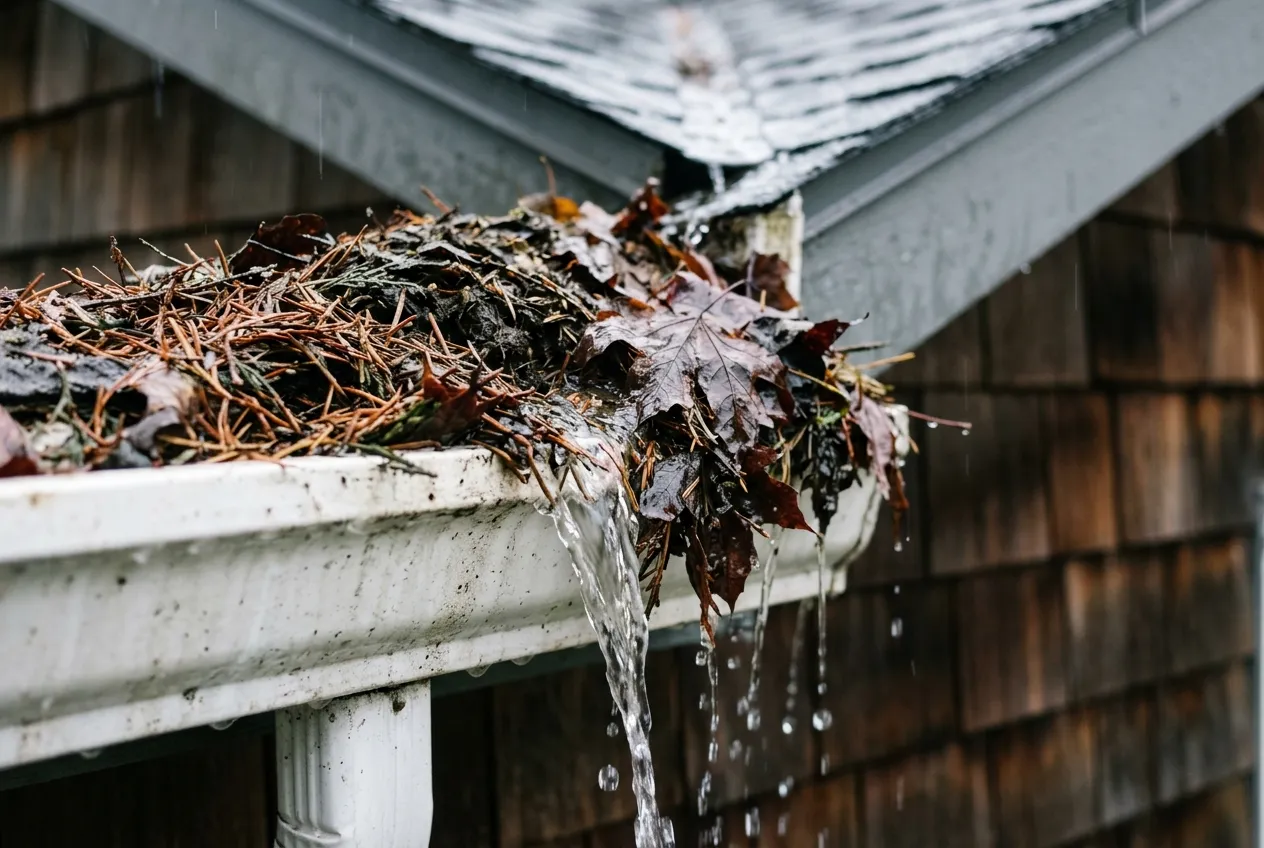
Under a maple, most guards work. Under a Douglas fir, most guards fail, and they fail in a way that is worse than having no guard at all, because you stop checking the gutter you can no longer see into.
The Clark County debris problem
Our problem debris is not leaves. It is:
- Fir needles, which are small, stiff, and drop year-round rather than in one autumn event
- Cedar scale, the tiny flat fronds that shed constantly
- Seed pods and catkins in spring
- Roof grit, the granules that wash off shingles over time and settle into the bottom of every gutter
Needles are the killer. They are thin enough to pass through or wedge into almost any screen, and once a mat of them forms it holds every other bit of debris that lands on it.
Neighborhoods under mature conifer canopy - Felida, La Center, Hockinson, the wooded lots around Brush Prairie - are where this matters most.
Screen guards
Perforated metal or plastic screens that sit over the gutter opening. The cheapest option and widely sold.
Works for: broadleaf debris. Maple, oak, birch.
Fails on: fir and cedar. Needles pass through the perforations or stand up in them, and the screen itself becomes the clog. Worse, the debris now sits on top of a lid you have to remove to clean, which makes maintenance harder than it was before.
If you have conifers, skip these. This is the guard that generates most of the complaints about guards in general.
Surface tension covers
Solid curved hoods that cover the gutter entirely, leaving a narrow slot at the front edge. Water clings to the curve and rolls into the slot; debris carries past and falls off the roof.
Works for: needles, reasonably well. This is a genuine option in the Pacific Northwest, and it was the standard answer here for years.
Limitations: heavy downpours can overshoot the slot, especially on steep roofs where water is already moving fast. The slot itself can accumulate grit and fine debris over time, and cleaning it is not a homeowner job. They also change the look of the eave noticeably, which some people mind.
Worth pairing with the 5-inch versus 6-inch gutter question, because on a steep roof the overshoot issue compounds.
Micro-mesh
A fine stainless mesh over a rigid frame, sitting on or in the gutter. The mesh is fine enough that needles and even roof grit stay out while water passes through.
Works for: essentially everything we deal with here, including fir needles and cedar scale. This is the option we recommend most often for properties under conifer canopy.
Limitations: it is the most expensive category. And it is not maintenance-free, despite how it is marketed. Fine debris and pollen can blind the mesh surface over time, which sheds water off the front instead of through it. The good news is that clearing a blinded mesh is a brush-off from a ladder rather than a scoop-out, so maintenance drops from an unpleasant job to a quick one.
Quality matters within the category. Fine mesh on a flimsy frame that sags or pops out of the gutter is a false economy.
Foam and brush inserts
Foam wedges or bristle cylinders that sit inside the gutter channel.
Cheap, easy to install yourself, and in our conditions they generally do not last. Both trap needles inside the gutter where you cannot see them, both degrade with UV, and foam in particular holds moisture and grows its own organic matter. We do not recommend them here.
The honest case for no guards
If your house has no overhanging trees, guards solve a problem you do not have. Clean the gutters once a year and spend the money elsewhere.
If your house is under heavy canopy and you are comfortable on a ladder twice a year, that is also a legitimate choice, and it is cheaper.
Guards make sense when the cleaning frequency is high, when the roof is steep or tall enough that you should not be on a ladder, or when repeated overflow has already started damaging fascia. That last one is the expensive scenario and it is the one worth preventing. Overflowing gutters soak fascia, and rotten fascia is what turns a gutter replacement into carpentry - see gutter installation cost in Vancouver, WA.
What guards do not fix
Undersized gutters. If a 5-inch gutter is overflowing on a steep roof, a guard does not add capacity.
Too few downspouts. The outlet is usually the bottleneck. Adding a downspout often solves what a guard was bought to solve.
Pitch problems. A gutter that does not drain toward the outlet holds water regardless of what is on top of it.
Moss on the roof. Guards keep debris out of the gutter and do nothing about what is growing above it. That is a separate job: see getting rid of moss on a roof.
A wall that is already wet. An overflowing gutter runs down the cladding it was meant to protect, and a downspout discharging at the foundation keeps the bottom course damp indefinitely. On heavily treed lots the gutters and the wall are one problem rather than two, which is why we look at them together on La Center siding work. Fixing the siding and leaving the water is a way to do the job twice.
How we spec them
Before we quote gutters and guards we look at what is actually growing over the house, because the tree mix is the whole answer. A property with a single ornamental maple and a property under three mature firs get different recommendations, and one of them may get no recommendation at all.
Free measure and quote across Clark County, and we will tell you if guards are not worth it on your house.