

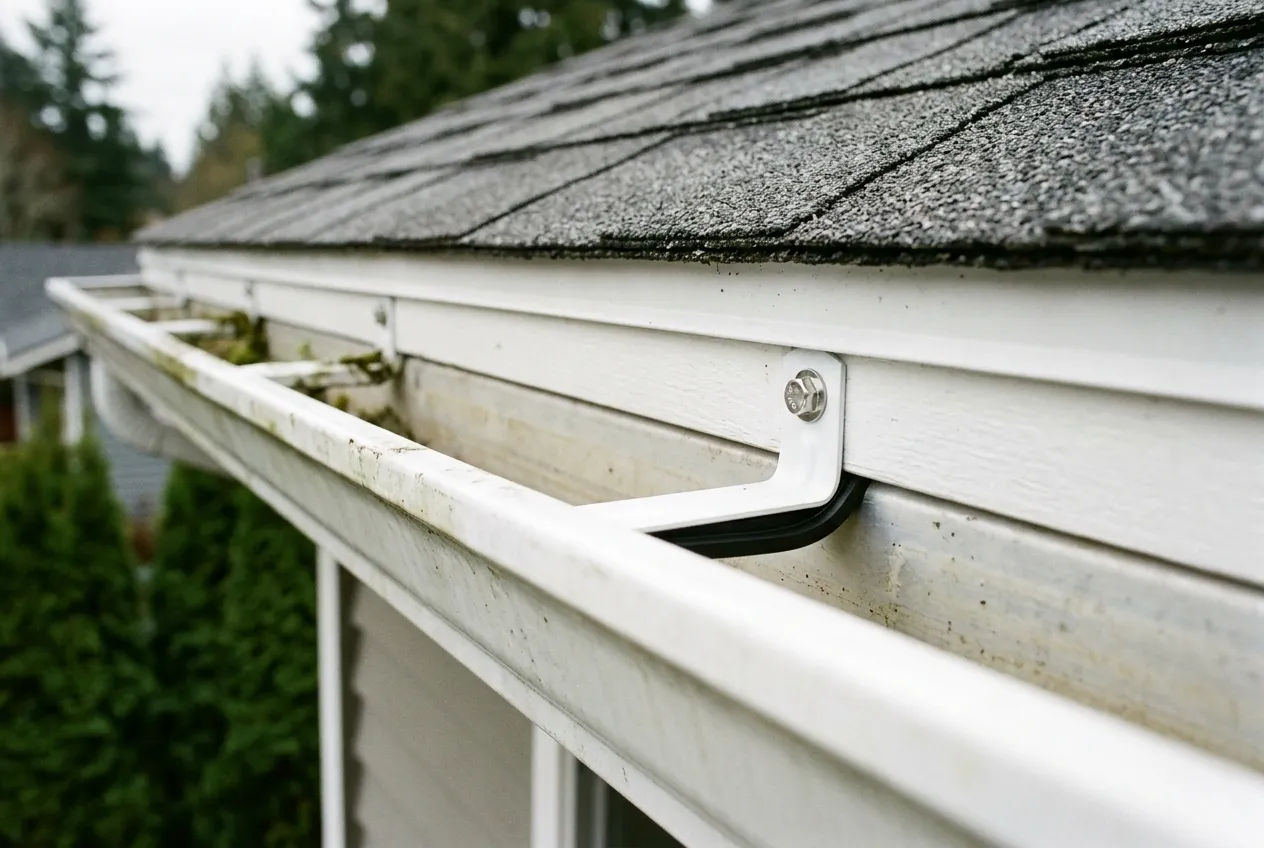
Water coming over a gutter’s front edge and water running behind the gutter can look similar from inside the house. They are different observations to give the contractor. Replacing a section without understanding the water path can leave the original concern unresolved.
If your gutters overflow during rain, start by recording where it happens from a sheltered, ground-level location. For gutter repair or replacement, a short video showing the problem can be more useful than a description given several dry days later.
Watch the water path from a safe location
Choose a viewpoint where you can see the gutter without standing below a loose section, climbing a ladder, or going near electrical equipment. Photograph the whole affected run and note the nearest corner or downspout.
Does water spill over the front along a long stretch, pour from one corner, drip through a joint, or appear between the gutter and fascia? Does the downspout discharge visibly, and where does that water go? These questions help frame the investigation; they do not identify the cause by themselves.
Record whether it occurs in ordinary rainfall or only during a heavier burst. Do not recreate a leak by spraying water into roof edges or wall openings. A contractor can decide whether a controlled test is needed and how it should be performed.
Overflow needs a drainage assessment
A gutter that spills over may have obstructed flow, a problem with its slope or outlets, or a configuration that does not suit the roof area feeding it. Ask the contractor to explain which condition was observed rather than jumping directly to a larger gutter.
Under trees in Hockinson, include the timing and type of debris you have noticed. For a home in Camas with several roof planes converging at one corner, point out the exact location where the flow concentrates. The recommendation should follow the roof and drainage layout on that house.
If cleaning resolves the immediate blockage, ask whether anything else needs attention. If a different size or outlet arrangement is proposed, ask which observation justifies the change. Our guide to 5-inch and 6-inch gutters introduces the sizing discussion, but the site assessment determines the installation.
Water behind the gutter deserves a roof-edge check
Water at the back of a gutter calls for a look at how the roof edge, gutter, and fascia meet. The contractor may need to investigate the attachment, the position of the gutter, and the details that direct water into it. The visible drip alone does not tell you which piece needs work.
Show any staining, peeling paint, sagging, or soft-looking trim from the ground. Do not press into damaged fascia from a ladder to see how far the damage goes. Ask whether a section must be opened to establish the condition and how any additional work will be approved.
If the roof edge needs attention, coordinate that with roofing repairs. Rehanging a gutter and repairing concealed wood are separate tasks unless the estimate explicitly includes both.
A leaking seam is a narrower question
A drip at a seam, corner, or end cap may lead to a localized repair, but first confirm that water is actually escaping at that joint. Water traveling along the underside can make the point where it falls different from the point where it entered.
Tell the contractor whether the joint has been repaired before and provide any records you have. Ask what preparation and repair method are proposed and whether the rest of that gutter run is serviceable. A history of repeated patches is relevant, but it does not by itself establish that the entire house needs new gutters.
Compare repair and replacement by scope
A proposal should identify the runs involved, material, color, attachment work, downspouts, and disposal. It should also clarify whether fascia repair, painting, roof-edge work, or changes to underground drainage are included.
For a partial replacement, discuss how it connects to the sections that remain. For a whole-house replacement, confirm discharge locations and any areas you want to keep clear of walkways or landscaping. Photograph those areas during the estimate so the intended result is easy to understand.
Keep a record after the work
Ask how to report a concern if water behaves unexpectedly after the next rain. Save the scope and before-and-after photographs. If a maintenance schedule is recommended, make sure it reflects your property’s debris exposure and safe access arrangements.
Send Quality Master Roofing & Remodel your gutter observations along with photos or a brief video. “Water runs behind the gutter at the back-left corner” gives the assessment a useful direction and helps keep the proposed repair tied to the problem you actually see.