Most people hire a roofer once or twice in their life, usually right after something has gone wrong. You’re comparing strangers on price, and the bids rarely describe the same job. This guide is the checklist we’d hand a friend in Vancouver who’s getting quotes, including from us.
We’re Quality Master Roofing & Remodel, a family-owned roofing contractor in Vancouver, WA. Everything below is something you can check on paper or online before you sign.
Start with what the written quote breaks out
A one-line number tells you nothing you can compare. A real roof estimate lists the parts of the job, so you can see which bid left something out. Ours always breaks out these seven:
- Tear-off. Down to the deck, and how many old layers are coming off.
- Decking allowance. The per-sheet rate for any soft plywood found once the old roof is off. It should be in writing before the job starts, so a rotten sheet is a known number and not a new negotiation from the roof.
- Underlayment. Synthetic, and where the ice and water shield goes. Valleys and penetrations are the usual spots.
- Shingle line. The actual product name. Standard architectural and heavy-duty wind-rated lines are different shingles at different prices.
- Flashing. Whether the chimney, wall and skylight flashing is new or reused. Reused flashing is where the next leak tends to start.
- Ventilation. Ridge vent and soffit intake, sized for your attic. A roof over a damp attic ages fast.
- Permit. Who pulls it. Every Clark County jurisdiction requires a permit for most residential re-roofs, and it should be on the estimate.
If one bid lists all seven and another doesn’t, ask the second roofer about the missing lines before you compare the totals. Our post on what drives roof replacement cost in Vancouver goes through each one in more detail, and roof permits in Clark County covers the permit side.
Check the license yourself
Any roofer working on your house should give you their license number without being asked. Then look it up. It’s free and it’s public record.
- Washington work: use the Washington L&I contractor verification tool. It shows whether the registration is active, plus the bond and insurance on file.
- Oregon work: use the Oregon Construction Contractors Board license search. Search by CCB number or business name.
Ours are WA CC QUALIML786JF and OR CCB 243945. We’re bonded and fully insured. Look us up the same way you’d look up anyone else.
Ask who certifies their installs
Shingle makers run installer programs, and they matter more than most people realize. A manufacturer’s system warranty, the kind that covers workmanship as well as materials, only applies when a certified installer does the job and registers it. If an uncertified crew installs your roof, you get the shingle warranty and that’s it.
So ask each bidder which programs they’re in, and whether they’ll register your roof. We’re a CertainTeed ShingleMaster and Master Shingle Applicator, and a Malarkey Emerald Pro and Certified Residential Contractor. We register every roof we put on, and you get a copy of the registration.
Look at their record, not just their reviews
Reviews help, but read a few that describe a job like yours rather than skimming the star count. Then check something a roofer can’t write themselves. Quality Master is a BBB Accredited Business with an A+ rating on our BBB profile.
Photos of real local jobs are worth asking for too. Ours are on our project write-ups, each with the city, what was wrong with the roof and what we did.
Find out who’s actually on your roof
Some companies sell the job and hand it to whoever’s free. Ask who will run your project, and who checks the work before it’s called finished.
At Quality Master, Victor Santiago, who founded the company in 2021, walks every project before sign-off. You deal with him directly rather than a sales rep.
Be careful after a storm
After a windstorm, out-of-area crews knock on doors with same-day prices and pressure to sign. Everything above still applies, and the license check matters most of all. Our guide to storm damage roof repair in Clark County covers what to do first and how to spot a storm chaser.
Where your house is changes the job
The right roofer for you knows what your area’s houses need. Hillside homes in Camas often run 8/12 to 12/12 pitches, which slows the crew and raises the per-square cost, so a Camas roofer should show you the pitch they measured. Rural lots around Battle Ground sit in the open and take more wind, which is why we spec 130 mph shingles on many roofs in Battle Ground. If a bid for your house reads exactly like a bid for any house, ask why.
Questions worth asking every roofer
- Can I have the quote in writing, broken out line by line?
- What’s your per-sheet decking rate?
- What are your license numbers, and are you bonded and insured?
- Which manufacturer certifications do you hold, and will you register my roof?
- Who pulls the permit?
- Who will be on site, and who checks the finished roof?
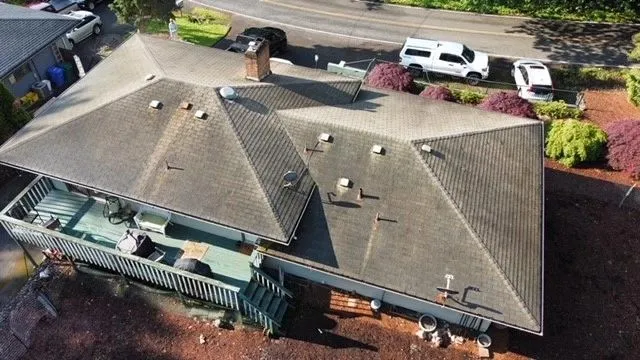
A good roofer is glad to answer all six. If you’d like us to be one of your bids, book a free inspection. You’ll get drone photos and a written estimate with every line above.